Hire Purchase
Spreads the cost over an agreed term with fixed repayments, while the business is treated as owning the asset for tax purposes from the outset, preserving AIA eligibility in the same way as a cash purchase.

Hire purchase and cash purchase for warehouse, distribution and manufacturing rooftop solar, sized against continuous refrigeration, automated handling and process loads. Built for logistics operators, manufacturers and industrial landlords, not domestic installers.
Of every sector this site covers, warehouses and industrial sites tend to make the strongest commercial case for solar, for a simple reason: roof area is usually large relative to the building's footprint, and the load behind it is often close to flat across the whole day rather than concentrated in a short window. A distribution centre running refrigeration around the clock, or a manufacturing site running process equipment through a shift pattern, self-consumes a much higher share of what it generates than a business with a short daytime peak, which changes the economics meaningfully. This page covers what's specific to warehouse and industrial roofs, on top of the routes, tax treatment and worked methodology covered in our main commercial solar finance guide.
It's tempting to size a warehouse solar system purely against available roof area, since there's often a lot of it. The stronger approach is to size it against the site's actual daytime electricity demand first, and let roof area set the ceiling rather than the target. A system that generates more than the site can use during daylight hours simply exports the surplus at a lower rate than it would have saved by self-consuming it, which weakens the return without changing the roof at all.
Sites with continuous refrigeration, cold storage, automated pick-and-pack systems or process equipment running through a shift pattern tend to have the flattest, highest daytime loads of any sector we cover, which is exactly what makes solar generation useful rather than mostly exported. A single-shift office-hours-only warehouse has a very different profile, and the right system size for it is usually smaller than the roof alone would suggest.
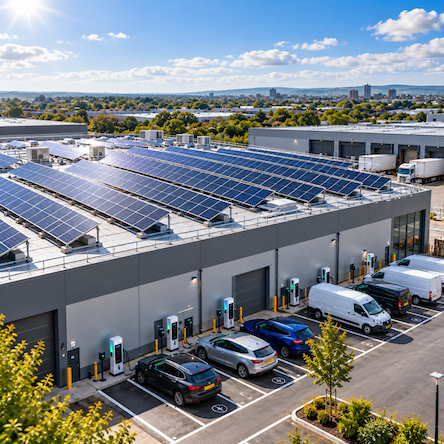
Eligible plant and machinery used in onsite renewable energy generation and storage, including rooftop solar panels, has been exempt from business rates in England since 1 April 2022, a date the government brought forward a year from the originally announced 1 April 2023, with the exemption running until 31 March 2035. The Valuation Office Agency does not include qualifying solar plant in a property's rateable value, so installing a system does not increase the business rates bill, and no separate application is generally needed for the exemption itself.
This matters more on an industrial roof than almost anywhere else in this cluster, simply because warehouse and manufacturing systems tend to be larger, so the rates exposure being removed would otherwise be larger too. The exemption is understood to apply to systems used primarily for the property's own consumption; systems set up mainly to export power, including some third-party owned PPA installations, can be treated differently, so it's worth confirming your specific structure with your rating advisor or the VOA rather than assuming it applies automatically to every arrangement.
Not every warehouse roof is the same. An older shed with a steel-sheet or built-up felt roof, possibly decades old, is a very different structural proposition to a modern steel portal-frame building with a single-ply membrane designed more recently. Loading capacity, membrane age and condition, and the type of fixing method used all need assessing by the installer before a system is specified, and a structural survey is a normal part of that process rather than an optional extra.
This matters for finance in the same way it does for any commercial roof: a lender's view of the asset is shaped in part by the condition of what it sits on. Getting the structural position confirmed before a system is designed avoids a scenario where finance has been discussed against a specification that later needs revising once the roof survey comes back.
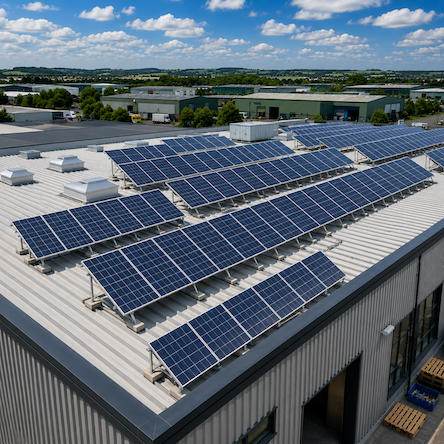
A single-occupier warehouse is the simplest case: whoever occupies the building also controls the roof and the electricity meter. A multi-let industrial estate or a unit within a larger scheme is not always that straightforward. Where the landlord owns the roof and individual tenants pay for their own electricity, there's a genuine question of who benefits from a solar installation and who pays for it, sometimes described as a split-incentive problem. Resolving this, usually through a clear agreement on cost, benefit and any service charge treatment, needs to happen before finance can be arranged, not as an afterthought once a system has been specified.
Where the occupier holds a long lease and controls their own supply, this is often more straightforward and closer to the owner-occupier position covered on our main guide.
Larger systems, which is where a lot of warehouse and industrial installations sit, need enough capacity at the site's grid connection to handle both the generation and any export. This is checked with the local Distribution Network Operator, and on some sites, particularly older industrial estates or areas with constrained local infrastructure, the available capacity can be lower than the system size a business would otherwise want to install. This is a planning question rather than a finance one, but it affects timelines and sometimes final system size, so it's worth raising with your installer and DNO early rather than discovering a constraint after finance has already been arranged.
Spreads the cost over an agreed term with fixed repayments, while the business is treated as owning the asset for tax purposes from the outset, preserving AIA eligibility in the same way as a cash purchase.
Full cost paid upfront. Straightforward where the business has the working capital available and wants to avoid finance charges entirely, with the same AIA treatment as hire purchase.
Considering a lease or PPA instead? These depend on contract-specific pricing and terms that we do not model with a generic formula. See the six-route comparison on our main guide for how they compare to hire purchase and cash purchase.
Composite illustration, not a real client. Same methodology as our main calculator: 850 kWh generated per installed kWp in Year 1, running costs and insurance at £12/kWp/year, hire purchase at an illustrative 8.5% nominal annual rate paid in advance over 120 months, VAT fully recoverable.
Run your own roof size, load profile and business type through the full calculator.
Avro arranges warehouse and industrial solar finance for limited companies, LLPs and established sole traders and partnerships, for business use only. Deals in this sector typically exceed the £25,000 threshold UK law (FSMA, article 60C) sets for a business finance agreement to qualify as exempt from consumer credit regulation.
Avro Asset Finance is a trading name of Avro Fleet Ltd. We do not provide consumer credit or regulated financial products; we arrange unregulated business finance agreements only, and this does not carry the same protections as a regulated consumer credit agreement. We are a broker, not a lender, and we receive commission from funders on completed deals, which varies by funder.
Nothing on this page is a quote, an offer, tax advice or rating advice. Figures are illustrative, subject to survey, funder credit approval and site-specific factors. Confirm current business rates treatment with the VOA or your rating advisor, and confirm AIA and tax treatment with your accountant before proceeding.
Warehouses with continuous cold storage, refrigeration or automated handling equipment often run a near-flat electricity load all day, so most generation is self-consumed rather than exported at the lower rate.
Yes, for onsite self-consumption systems. Eligible rooftop solar has been exempt from business rates in England since 1 April 2022, running until 31 March 2035, confirmed by the Valuation Office Agency. Export-focused or third-party owned PPA systems may be treated differently.
It depends on who controls the roof and electricity supply. Landlord consent and a clear agreement on who benefits from the system are needed before finance can be arranged.
Yes. Roof structure, loading capacity and membrane condition vary significantly between older sheds and modern buildings, and should be surveyed by the installer first.
Warehouse and industrial roofs are often the largest we see, and systems in the 100kW to 200kW range are common, sized against roof area and daytime demand.
It can. Larger systems need sufficient capacity at the site's grid connection, checked with the DNO early since it can affect timelines and final system size.
All six funding routes compared, with the AIA argument covered in full.
Run your own roof size, load profile and business type.
For distribution and logistics operators also financing their fleet.