Hire Purchase
Spreads the cost over an agreed term with fixed repayments, while the business is treated as owning the asset for tax purposes from the outset, preserving AIA eligibility in the same way as a cash purchase.

Hire purchase and cash purchase for continuously occupied buildings with heating, hot water, laundry and kitchen loads running around the clock. Built for care operators and hoteliers, not domestic installers.
Care homes and hotels share a feature most other commercial buildings don't have: they're occupied, and drawing power, every hour of every day. That sounds like an ideal match for solar, and in some respects it is, but the honest picture is more nuanced than "24/7 load equals maximum solar benefit." Roof area relative to the size of the building is often more modest than a warehouse or farm, and a meaningful share of the load happens overnight, when solar generates nothing at all regardless of system size. This page covers what's genuinely specific to care home and hotel roofs, on top of the routes, tax treatment and worked methodology covered in our main commercial solar finance guide.
Heating, hot water, laundry, kitchen equipment, lighting and nurse-call or building management systems in a care home, or heating, hot water, laundry, kitchen and guest facilities in a hotel, all run continuously rather than in a short daytime window. During daylight hours, that gives solar a strong, consistent load to self-consume against, and self-consumption rates on the generation that does happen during the day are typically high.
What that framing leaves out, and what a lot of solar content skips over, is that roughly half the day is dark. Whatever the building consumes overnight gets no benefit from the solar system at all, however it's sized, because there's no generation to offset it. So while the daytime self-consumption rate can look excellent, the achievable share of the building's total 24-hour consumption that solar can realistically offset is naturally lower than for a business that only operates in daylight hours. That's not a reason to rule solar out, it's a reason to size expectations correctly from the outset rather than being sold a headline self-consumption figure that only describes part of the day.
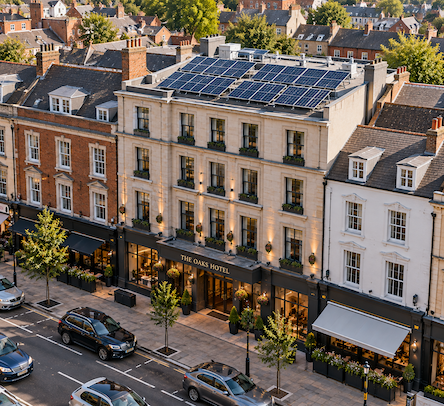
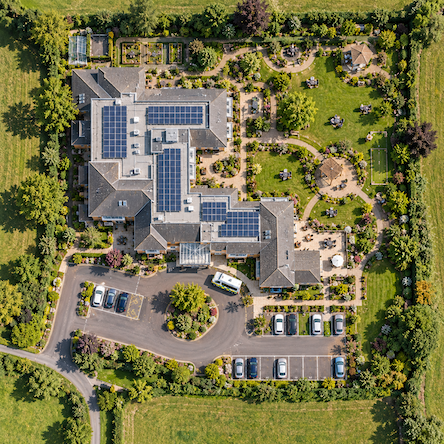
A single-storey warehouse or a large barn roof often has generous roof area relative to what sits underneath it. A multi-storey care home or hotel is the opposite: several floors of rooms, kitchens and communal areas sit under a comparatively modest roof footprint. That usually means the system is sized to whatever roof area is genuinely available, rather than to the building's total electricity demand, which the roof alone often can't come close to covering.
The practical result is that a well-sized system on a care home or hotel roof tends to achieve very high self-consumption of what it generates, since the building can absorb it easily, but the generation itself is often a modest slice of the total energy bill rather than a dominant one. That's a genuinely different economic shape to a warehouse system, and it's worth going into a project with that expectation rather than one borrowed from a much larger industrial roof.
A large share of the UK care home sector operates under a split structure, where an operating company runs the day-to-day business and a separate property company owns the building itself, sometimes an institutional landlord entirely unconnected to the care operator. Hotels can follow a similar pattern, particularly within larger groups or franchised properties. Where that split exists, consent from the property owner is typically needed before a solar installation and its finance can proceed, since it's a permanent alteration to a building the operating business doesn't own.
This is worth raising early, alongside any roof survey, rather than discovering partway through a project that the freeholder's agreement is a separate conversation to the one about the electricity bill.
A care home or hotel doesn't close for a solar installation the way an empty warehouse might be able to schedule work around a quieter period. Residents, staff and guests remain on site throughout, so access routes, scaffolding, noise and timing around communal or resident-facing areas all need planning with the installer in a way that a purely operational commercial building doesn't have to think about as carefully. This is a genuine project management consideration, not a reason to avoid solar, but it's worth discussing directly with your installer and, where relevant, your care regulator's requirements around building works, before committing to a timeline.
We looked specifically for a dedicated grant scheme covering privately operated care home or hotel solar installations and did not find one we could verify. The Public Sector Decarbonisation Scheme is real and does fund solar as part of wider decarbonisation programmes, but it's restricted to public sector bodies such as NHS trusts and schools, and does not extend to privately run care homes or hotels, even where care is commissioned by a local authority or the NHS.
Be cautious of specific figures quoted elsewhere. Some commercial sites quote precise energy usage, payback periods and grant amounts for care homes and hotels that we could not independently verify. We'd rather tell you plainly that we couldn't confirm those figures than repeat them.
What does apply, on the same basis as any other commercial sector, is the standard set of business routes: the Annual Investment Allowance on qualifying capital expenditure, VAT recovery for VAT-registered businesses, and the business rates exemption for onsite self-consumption solar running until 31 March 2035. These are covered in full on our main commercial solar finance guide.
Spreads the cost over an agreed term with fixed repayments, while the business is treated as owning the asset for tax purposes from the outset, preserving AIA eligibility in the same way as a cash purchase.
Full cost paid upfront. Straightforward where the business has the working capital available and prefers to avoid finance charges, with the same AIA treatment as hire purchase.
Considering a lease or PPA instead? These depend on contract-specific pricing and terms that we do not model with a generic formula. See the six-route comparison on our main guide for how they compare to hire purchase and cash purchase.
Composite illustration, not a real client. Same methodology as our main calculator: 850 kWh generated per installed kWp in Year 1, running costs and insurance at £12/kWp/year, hire purchase at an illustrative 8.5% nominal annual rate paid in advance over 120 months, VAT fully recoverable.
Run your own roof size, load profile and business type through the full calculator.
Avro arranges care home and hotel solar finance for limited companies, LLPs and established sole traders and partnerships, for business use only. Deals in this sector typically exceed the £25,000 threshold UK law (FSMA, article 60C) sets for a business finance agreement to qualify as exempt from consumer credit regulation.
Avro Asset Finance is a trading name of Avro Fleet Ltd. We do not provide consumer credit or regulated financial products; we arrange unregulated business finance agreements only, and this does not carry the same protections as a regulated consumer credit agreement. We are a broker, not a lender, and we receive commission from funders on completed deals, which varies by funder.
Nothing on this page is a quote, an offer, tax advice or grant advice. Figures are illustrative, subject to survey, funder credit approval and site-specific factors. Confirm current grant, VAT and business rates treatment directly, and confirm AIA and tax treatment with your accountant before proceeding.
It can be, but overnight consumption gets no benefit from solar, since panels only generate in daylight. Daytime self-consumption tends to be high, but the achievable share of total 24-hour consumption is naturally lower than for a daylight-only business.
We are not aware of a dedicated scheme for privately operated care homes or hotels as of 2026. The Public Sector Decarbonisation Scheme exists but is restricted to public sector bodies and does not apply here. Standard AIA, VAT and business rates routes apply as they would for any commercial sector.
Potentially, yes, subject to the property owner's consent, which is typically needed given the common operating company / property company split in the sector.
Usually, yes, with access, scaffolding and timing carefully sequenced around continued occupation, discussed directly with the installer.
Generally yes, for onsite self-consumption systems, on the same basis as any other UK commercial property, exempt since 1 April 2022 until 31 March 2035.
Roof area relative to total energy use is often modest, so systems are typically sized to available roof space rather than total consumption, usually smaller than the largest industrial systems.
All six funding routes compared, with the AIA argument covered in full.
Run your own roof size, load profile and business type.
For care and hospitality operators also financing transport vehicles.