1
Production companies & studios
Large or small, independent or corporate.
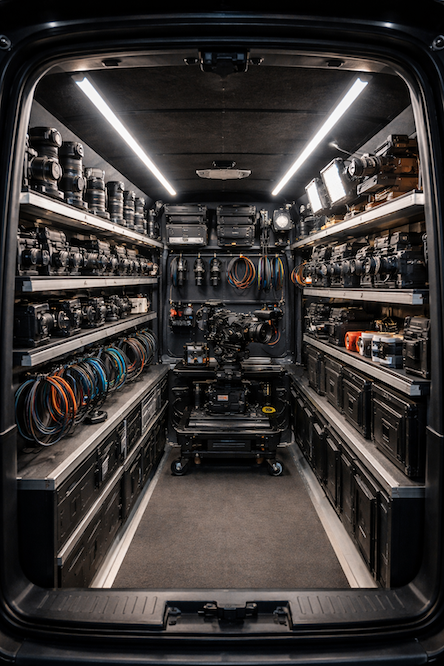
Avro supports production companies, studios, crew and transport providers, freelancers and specialist vehicle operators with finance for camera vans, unit trucks, generator and lighting vehicles, crew transport and executive cast vehicles. This is manually underwritten commercial funding shaped by production schedules, vehicle presentation and asset value, not a standard retail motor finance product.
In film and television, transport is part of the production itself. Moving cameras, lighting rigs, sets, wardrobe, cast and crew on schedule keeps a shoot on budget and on time, and the vehicles doing that job are working assets, not just company cars. A single camera van, a unit truck for a location shoot, a fleet of crew minibuses for a longer production, or a refinance of vehicles a production company already owns can each raise different underwriting questions, which is why production vehicle finance benefits from a specialist, manually assessed approach rather than a generic commercial vehicle loan.
From camera vans to unit trucks and crew transport, coverage extends across the full range of vehicles a production relies on.
Fitted vehicles carrying camera, lens, rigging and grip equipment.
Mobile production offices for on-location coordination.
Vehicles supporting scouting, logistics and location setup teams.
For moving set pieces, wardrobe and production equipment.
Suited to oversized or heavy set and equipment loads.
For larger productions moving substantial volumes of kit and sets.
Technical support vehicles powering lighting and on-set equipment.
Vehicles forming the operational base for cast and crew on location.
Crew welfare trailers with dressing rooms and facilities on location.
Private trailers for lead cast between takes.
Fitted transport and storage for costume departments.
For extras, crew and location staff transport.
For actors, directors and VIP transport.
Comfortable crew movement between sets, hotels and locations.
Lower-emission vans, cars and support vehicles for greener productions.
Production vehicle finance is used by a genuinely broad range of businesses, from a sole trader camera operator financing a single fitted van to a studio coordinating a fleet of trucks and crew transport across a multi-month shoot. Treating those as the same client would miss what actually matters to each of them, which is why this category needs case-by-case underwriting rather than a one-size approach.
We work with production companies and studios of all sizes, crew and transport providers, freelancers and sole traders including camera operators, gaffers and lighting technicians, specialist vehicle operators providing bespoke film transport, equipment rental and grip and lighting hire houses, event and live production companies, and advertising and commercial production businesses.
Large or small, independent or corporate.
Fleet operators, unit drivers and logistics firms.
Camera operators, gaffers and lighting technicians.
Companies providing bespoke film transport solutions.
Adjust the figures below to estimate indicative monthly payments for a camera van, unit truck or production fleet purchase.
Estimated Monthly Payment
This calculator is for illustration only. Actual finance terms depend on lender approval, borrower profile, deposit, vehicle type, age, structure, underwriting and lender criteria. The business profile selector is used only to estimate the illustration and does not guarantee acceptance or a specific rate.
Suitability depends on the vehicle, the fit-out and the operator, not simply whether the asset is new or used.
A clean compliance and presentation standard, useful where production clients expect newer kit.
Can control capital outlay where age, mileage and fit-out condition are suitable.
May offer relatively recent stock without a full new-build cost.
Considered case by case based on conversion standard and remaining service life.
A newly fitted-out camera van and an older used unit truck bought through the secondhand commercial market are different propositions, and the funding approach should reflect that rather than pretending otherwise. New vehicles typically offer the cleanest compliance position and the most predictable early maintenance, which matters where a vehicle needs to turn up looking the part for a client production. Used vehicles can be a sensible route for operators managing budget carefully, but age, mileage, fit-out condition, documented history and presentation standard all carry real weight in the assessment.
Fleet renewal is its own category. Where a production company is replacing or expanding a fleet of camera vans, unit trucks or crew vehicles, the funding conversation typically needs to account for delivery lead times, existing production commitments and how the transition affects vehicle availability across live and upcoming shoots.
Most production vehicles start life as a standard commercial chassis before fit-out for camera, grip, lighting or crew use.
Sprinter is widely used as a base for camera vans and crew transport.
Transit and Transit Custom feature widely in grip and crew vehicles.
Crafter and Transporter platforms used across production fleets.
Daily platform used for larger unit trucks and box body builds.
Used as a base for larger box lorries and curtain-sider builds.
TGE and larger models used for production and equipment trucks.
Used in larger articulated and heavy production transport.
Estate and SUV models used for unit and crew cars.
Beyond the base chassis, the quality of the fit-out matters to how a lender views a production vehicle. A well-specified conversion, with proper storage, power and rigging for camera, grip or lighting equipment, and a documented build history, is generally easier to assess and finance than an undocumented or improvised fit-out, even where the underlying chassis is comparable. We do not name specific fit-out or conversion companies on this page because the market includes many regional and specialist builders and we would rather point you toward a properly evidenced conversion than assume one supplier over another.
Production schedules do not wait for a vehicle to be sourced and funded. A confirmed shoot with a fixed start date, a multi-location production needing several unit vehicles at once, or a studio running several productions in parallel all create pressure to have the right vehicles available on time, which is where fleet planning becomes a genuine commercial issue rather than a nice-to-have.
A well-planned fleet strategy typically covers phased vehicle replacement rather than reactive one-off purchases, cashflow planning that spreads capital outlay across a production slate rather than concentrating it around one shoot, and a clear view of how vehicles are utilised between productions. For companies running multiple simultaneous productions, standardising vehicle specification can also simplify crew training, maintenance and scheduling.
Fleet transactions may sit alongside wider Fleet Finance planning where a production or transport company is managing vehicles across more than one contract or client relationship.
Many production and transport companies already hold real value in vehicles they own outright or have largely paid down, and refinance can be a practical way to put that value to work rather than leaving it tied up between productions. Refinance may suit a business wanting to release working capital ahead of a busy production season, restructure existing borrowing, or free up cashflow between contracted jobs.
The amount available depends on the valuation of the existing vehicles, any outstanding finance against them, the operator's trading position and lender appetite for the asset. As with new purchase finance, fit-out quality, documented history and vehicle condition materially affect how existing production vehicles are valued for refinance purposes.
Sustainability is now a standing part of UK production planning. BAFTA Albert certification, the industry-recognised standard for environmental sustainability in film and TV production, is required or expected by major UK broadcasters and streamers, and productions are increasingly asked to measure and evidence their carbon footprint from pre-production onward. Transport is one of the areas productions are asked to account for, which is why vehicle choice can matter beyond day-to-day running cost.
Financing electric or hybrid vans, cars and support vehicles can support a production's sustainability reporting alongside the underlying commercial case for the vehicle. That does not mean every role within a production fleet suits full electrification today. Route length, equipment power draw, charging access on location and total cost of ownership all need to be weighed against the practical reality of keeping a production moving. For many operators, the realistic approach is introducing lower-emission vehicles into roles that suit them, such as crew and unit cars, while heavier equipment and generator vehicles convert as suitable options mature.
Financing a lower-emission fleet does not, on its own, achieve or guarantee Albert certification, which depends on wider production practices and reporting. It can, however, be one practical part of a production company's broader environmental approach where that is a genuine business priority.
The most suitable route depends on the vehicle, the production business and the wider commercial objective.
May suit operators who want to spread the cost of a vehicle over an agreed term with fixed repayments and a clear route to ownership once all contractual sums and any option to purchase fee have been paid.
May be relevant where lower monthly payments are wanted by deferring part of the balance to a contractual final payment, subject to vehicle and lender criteria.
May suit operators who want to use a vehicle for a fixed term with a choice of end options, rather than committing to ownership from the outset.
May suit operators who already own suitable vehicles and want to release capital, restructure borrowing or support further investment, subject to valuation and lender criteria.
Requirements vary by lender, vehicle and structure, but information may include business accounts, management information, bank statements, supplier or converter quotations, vehicle specification, and details of any existing finance where refinance is involved. Freelancers and sole traders may be asked for evidence of trading history and typical production income, while larger production companies may be asked for evidence of confirmed or upcoming production commitments where relevant to the case.
The following is a composite, illustrative example built to show how a case in this category is typically approached. It is not a description of one specific client.
Consider a mid-sized production company that has secured a run of commissioned work and needs to expand its vehicle capacity to cover two location shoots running in parallel, including a fitted camera van and a crew minibus. The commercial challenge is not simply financing two vehicles, but timing delivery against confirmed shoot dates and structuring repayments in a way that reflects the seasonal, project-based nature of production income rather than assuming steady monthly revenue.
In a case of this kind, manual assessment typically matters because the vehicles, the business's production pipeline and its cashflow pattern all need proper review rather than a generic scoring approach. A structure that aligns delivery with confirmed production dates can allow the company to bring capacity online exactly when it is needed rather than carrying cost ahead of demand. As with any specialist commercial case, the specific structure available depends on the asset, the business and lender criteria at the time.
A conversation about the business, the vehicle or fleet requirement, and the objective behind the funding.
The proposed vehicle, supplier, term and deposit are reviewed to identify sensible funding routes.
Supporting information may include accounts, bank statements, quotations and vehicle specification.
The case is considered against lender criteria, vehicle suitability and business profile.
If approved, terms can be reviewed and accepted subject to any conditions and final checks.
Once satisfied, the transaction completes and the business proceeds with acquisition, refinance or fleet expansion.
Approval is not based on one factor alone. Lenders may consider the business profile, trading history, credit background, deposit, invoice value, vehicle age, condition, intended use and whether the asset is viewed as suitable security for the agreement.
Used and fitted-out vehicles can often be considered, but conversion standard, documentation, age and presentation may influence the structure available. Refinance may also be possible on suitable existing vehicles where there is sufficient value and the wider case meets lender criteria.
All finance is subject to status, underwriting and lender criteria. Terms, availability and structure depend on the business, the asset and the overall transaction. The purpose is to identify suitable commercial funding routes, not to imply guaranteed approval.
Commercial funding used by production companies and crew to acquire, replace or refinance vehicles used to support filming, including camera vans, unit trucks, generator lorries and crew transport.
Yes, in suitable cases, subject to business profile and lender criteria.
In many cases, yes, subject to vehicle age, conversion condition, mileage and lender criteria.
Yes, in suitable cases, with multiple vehicles funded together or in stages as a coordinated fleet transaction.
Potentially, yes, subject to the asset specification and lender criteria.
Yes, in suitable cases, as part of production fleet finance.
Potentially, yes, where there is sufficient value in the existing vehicle and the case meets lender criteria.
Newer companies may be considered, though structure, deposit and lender appetite may differ from an established operator.
Yes, in suitable cases, subject to vehicle type, business profile and lender criteria.
Yes, in suitable cases, including 7.5t-18t box lorries, curtain siders, Hiab lorries and articulated trucks.
Yes, subject to vehicle and business criteria, for cast, director and VIP transport.
Typically business accounts, bank statements, supplier or converter quotations, vehicle specification and existing finance details where relevant.
Operator profile, trading history, deposit, vehicle age, condition, intended use, term requested and lender appetite.
Yes, in suitable cases, subject to business profile and lender criteria.
Certification itself does not determine lending decisions, but financing lower-emission vehicles may support a production's wider sustainability reporting.
Yes, individually or as part of a wider fleet.
Coordinated funding for multi-vehicle and phased fleet transactions.
Funding for panel vans and light commercials used in wider operations.
Chauffeur-standard cars for cast, director and VIP transport.
For larger crew and cast transport requirements.
Whether you’re managing your first short film or overseeing a major studio production, Avro Finance can help you keep things rolling.
Call our production finance specialists to discuss your fleet requirements.
Or enquire online to receive a tailored quote for your next project.
Apply now or enquire today to find out how we can help you secure the vehicles needed to keep your operations running smoothly.